With the advancement of Industry 4.0 and the deepening development of intelligent manufacturing, Wood Shaving Baling Machine, as specialized packaging equipment, are standing at a crossroads of technological upgrading, and their future development trends are becoming increasingly clear. These trends will not only improve the performance of the equipment itself but also profoundly change the operational model of wood chip packaging and even the entire material handling process.
Intelligentization and data interconnection are the primary directions. Future Wood Shaving Baling Machine will not merely be machines performing simple repetitive actions, but rather intelligent nodes in the factory’s Internet of Things (IoT). The equipment will integrate more and more sensitive sensors to monitor its own operating status (such as vibration, temperature, and pressure), material flow, and packaging quality in real time. All data, including output, efficiency, fault alarms, and energy consumption, will be uploaded to the cloud or the factory’s MES (Manufacturing Execution System) in real time via the network. Managers can remotely monitor the operation of multiple machines via mobile phone or computer, enabling predictive maintenance: the system can provide early warnings before components are completely damaged by analyzing data trends, thereby arranging planned maintenance and preventing unexpected downtime. Furthermore, by integrating data with upstream production systems and downstream logistics systems, truly flexible production and intelligent scheduling can be achieved.
Modular and flexible design will become standard features. To adapt to the market demand for small-batch, multi-variety production, future equipment will be composed of highly standardized functional modules, much like building blocks. Customers can quickly select or replace different feeding, weighing, bagging, and conveying modules as needed to handle changes in wood chip characteristics and packaging specifications, significantly reducing changeover time. The widespread application of robotic arms will enhance the flexibility and precision of bagging operations, enabling the handling of more complex bag shapes.
Finally, ergonomics and sustainability will receive unprecedented attention. Equipment interfaces will be more user-friendly, potentially employing augmented reality (AR) technology for assisted maintenance and troubleshooting. Energy consumption will be further reduced through the use of more efficient motors and drive systems. The equipment itself will utilize more recyclable or environmentally friendly materials, with ease of disassembly and recycling considered from the design stage. Simultaneously, dust and noise control standards will be higher, creating a near-cleanroom working environment for operators. In short, future wood chip bagging machines will evolve towards greater intelligence, flexibility, greener operation, and user-friendliness, continuously providing a powerful impetus for the transformation and upgrading of the wood products processing industry.
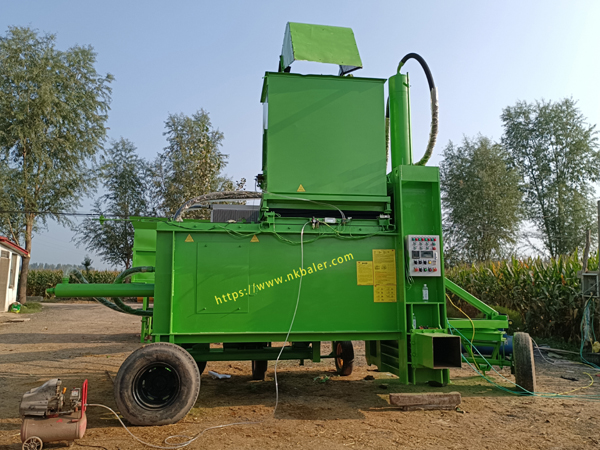
Nick Baler’s Wood Shaving Baling Machine offer a high-efficiency solution for compressing, bagging, and sealing lightweight, loose materials, including agricultural waste, sawdust, wood shavings, textiles, fibers, wipers, and biomass waste. By converting loose materials into compact, easy-to-handle bags, these machines ensure efficient storage, improved cleanliness, and minimized material loss.
Whether you’re in the livestock bedding industry, textile recycling, agricultural processing, or biomass fuel production, Nick Baler’s advanced bagging balers help streamline operations by reducing waste volume and improving material handling. With over 20 years of experience, we deliver customized solutions that enhance efficiency, durability, and automation in material packaging.
https://www.nkbaler.com
Email:Sales@nkbaler.com
WhatsApp:+86 15021631102
Post time: Jan-13-2026