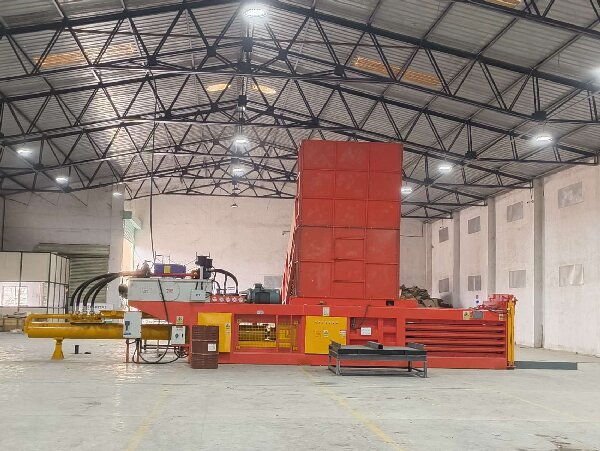
Stepping into a modern waste paper recycling station, the Cardboard Baling Machine is often the most prominent “heart” of the workshop. How does it transform mountains of loose waste paper into neat and sturdy bales, thereby greatly improving storage and transportation efficiency? Behind its efficient operation lies a scientific process design and reasonable operating procedures.
Efficient operation begins with pre-processing. The recycled waste paper raw materials undergo preliminary sorting to remove incompressible impurities such as plastics and metals. This not only protects the baler’s hydraulic system and blades but also ensures the purity and value of the final bales. Subsequently, the waste paper is evenly fed into the baler’s hopper via conveyor belt or forklift. Modern large-scale balers often employ pre-compression technology, where a pre-compression head initially squeezes the loose waste paper before the main compression, significantly increasing the single-pass feed volume and reducing the number of compression cycles—a crucial step in improving efficiency. The core compression process is driven by a powerful hydraulic system. When the hopper is full, the main compression head, pushed by the hydraulic cylinder, squeezes the waste paper towards a fixed end with enormous pressure. How many tons of pressure can be reached during this process? This directly determines the final density of the paper bales. High-density baling not only saves space but also effectively reduces transportation costs.
After compression, the threading or strapping system automatically binds the formed paper bales with metal wire or plastic strapping to prevent them from springing back and unraveling. Finally, the bale exit door opens, and the ejector mechanism delivers the heavy bales to the shipping area. The higher the degree of automation in the entire process, the less reliance on manual labor, and the more stable and faster the operating rhythm. For example, models equipped with automatic thread feeding, strapping, and bale ejection functions can form a near-continuous production cycle. However, efficient operation also relies on daily lean management. Regularly checking the hydraulic oil condition, whether the filter is clogged, whether the cylinder seals are worn, and keeping the threading channel unobstructed are all necessary measures to ensure the continuous and stable operation of the equipment.
Therefore, the efficient operation of a Cardboard Baling Machine is the result of the combined effect of excellent equipment, reasonable processes, and standardized maintenance. For recycling station operators, considering “how to maximize the output of this equipment through process optimization and maintenance?” is far more practical than simply pursuing equipment speed.
Industries That Benefit from Paper & Cardboard Balers
Packaging & Manufacturing – Compact leftover cartons,corrugated boxes,and paper waste.
Retail & Distribution Centers – Manage high-volume packaging waste effectively.
Recycling & Waste Management – Convert paper waste into recyclable,high-value bales.
Publishing & Printing – Dispose of outdated newspapers,books,and office paper efficiently.
Logistics & Warehousing – Reduce OCC and packaging waste for streamlined operations.
Nick -produced Cardboard Baling Machine can compress all kinds of cardboard boxes,waste paper,waste plastic,carton and other compressed packaging to reduce the cost of transportation and smelting.
https://www.nkbaler.com
Email:Sales@nkbaler.com
WhatsApp:+86 15021631102
Post time: Jan-14-2026