When purchasing a plastic bottle baling machine, users often face the dilemma of choosing between “fully automatic” and “semi-automatic.” The two differ significantly in price, efficiency, and application scenarios. Understanding their core differences helps in making the best decision based on one’s own needs.
Semi-automatic plastic bottle baling machines, as the name suggests, require more manual intervention to complete some key processes. A typical operating procedure is: manual input of plastic bottles into the hopper -> pressing the start button, the machine automatically compresses and maintains pressure -> manual threading and bundling -> manual release of pressure and ejection of the baler. Its advantages include lower initial investment costs, relatively simple equipment structure, and easier maintenance. It is suitable for small and medium-sized recycling stations or startups with low throughput, limited investment budgets, or relatively low labor costs. Its limitations are also obvious: production efficiency is limited by the speed of manual operation, labor intensity is relatively high, and the consistency of the balers (such as bundling tightness and appearance) may fluctuate depending on the operator.
Fully automatic plastic bottle baling machines, on the other hand, represent a highly integrated solution. It is typically equipped with an automatic feeding conveyor belt, an automatic compression device, an automatic strapping mechanism (threading, tightening, locking, and cutting), and an automatic ejection or conveying device for finished bales. The entire process, from material input to bale output, requires virtually no direct human intervention in equipment operation, only monitoring and occasional replenishment of consumables such as strapping tape. Its core advantages are extremely high production efficiency and stability, enabling 24-hour continuous operation with uniform bales size, greatly saving manpower. Simultaneously, due to reduced opportunities for human intervention in hazardous areas, safety is relatively higher. Of course, its price is significantly higher than semi-automatic models, and it also requires higher standards in terms of power supply, site conditions, and the technical skills of operators. It is more suitable for large-scale recycling centers or renewable resource processing bases with huge daily processing volumes and a pursuit of economies of scale.
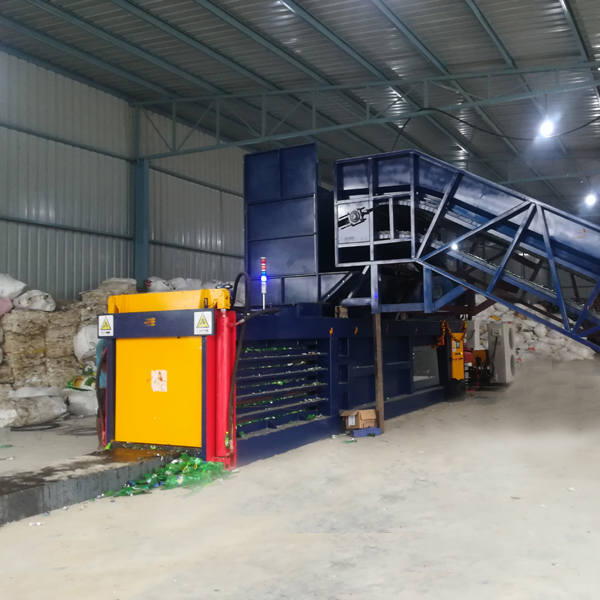
Nick Baler’s plastic and PET bottle balers provide an efficient, cost-effective solution for compacting plastic waste, including PET bottles, plastic film, HDPE containers, and shrink wrap. Designed for waste management facilities, recycling plants, and plastic manufacturers, these balers help reduce plastic waste volume by over 80%, optimize storage, and improve transportation efficiency.
With options ranging from manual to fully automatic models, Nick Baler’s machines enhance waste processing speed, minimize labor costs, and increase operational efficiency for industries handling large-scale plastic waste recycling.
https://www.nkbaler.com
Email:Sales@nkbaler.com
WhatsApp:+86 15021631102
Post time: Feb-04-2026