Seemingly bulky Silage Baling Press contains ingenious mechanical and hydraulic technology. Its working principle essentially mimics and amplifies human actions of “compacting” and “binding,” but its efficiency and power far surpass human capabilities. The entire process can be clearly divided into four stages: feeding, compression, baling, and ejection.
First, the cut and dried alfalfa hay is evenly fed into the baler’s “belly”—the compression chamber—either by a conveyor or manually. This is the starting point of the baling process; the evenness of feeding directly affects the quality of the final bale. Then, the machine’s core component begins its work: hydraulically driven pistons or pressure plates repeatedly compress the hay within the chamber with immense pressure, sometimes reaching tens or even hundreds of tons. During this process, air between the hay cells is forcefully expelled, and the volume is compressed to a fraction of its original size, becoming exceptionally dense.
When the hay is compressed to the predetermined density, the machine automatically enters the baling stage. At this point, a needle-threading device carries sturdy binding rope or wire, precisely threading it through the highly compressed hay bale to perform horizontal or vertical binding. Different models of balers may use hemp rope, plastic rope, or wire, and tie a specific number of knots to ensure the bales don’t unravel during subsequent handling and stacking.
Finally, the rear door of the compression chamber opens, and the formed, square or round, tightly packed bales are smoothly pushed out, either rolling or transported by conveyor belt to the designated location. The entire process can be completed from the operator’s cab via an electronic control system, achieving a high degree of automation and significantly reducing the operator’s workload. Understanding its working principle helps users better operate and maintain the equipment, maximizing its efficiency.
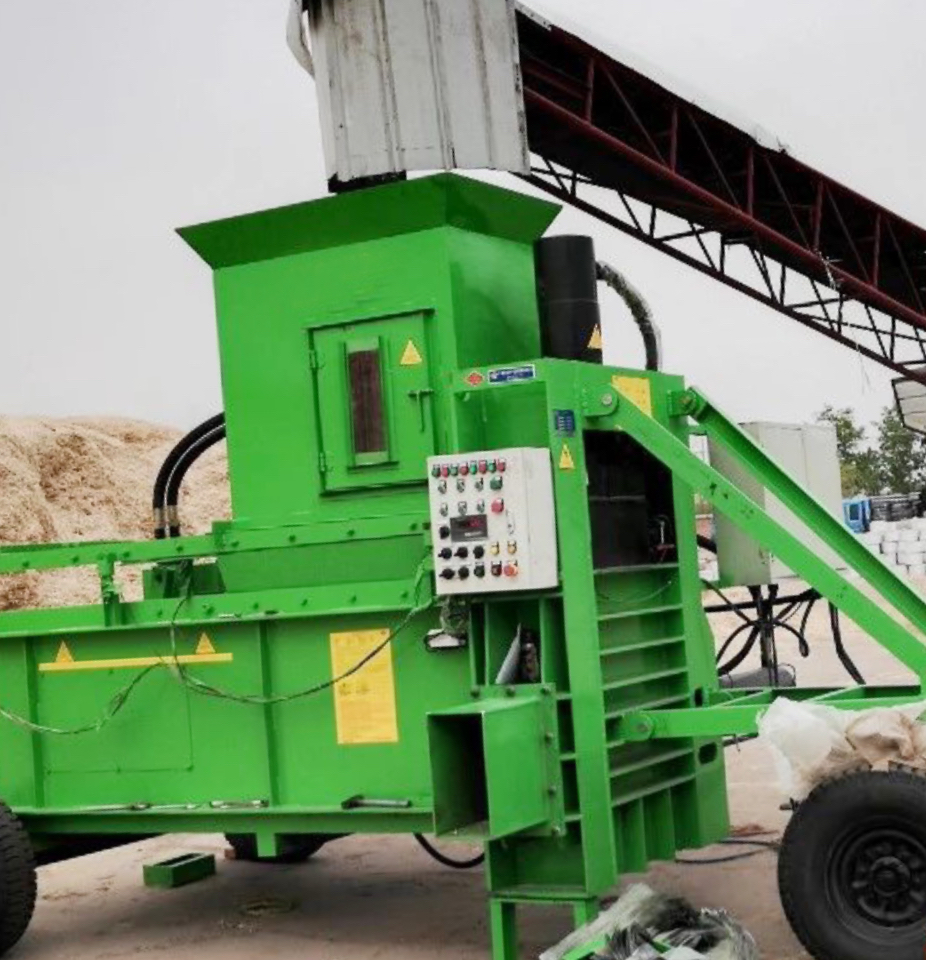
Nick Baler’s bagging machines offer a high-efficiency solution for compressing, bagging, and sealing lightweight, loose materials, including agricultural waste, sawdust, wood shavings, textiles, fibers, wipers, and biomass waste. By converting loose materials into compact, easy-to-handle bags, these machines ensure efficient storage, improved cleanliness, and minimized material loss.
Whether you’re in the livestock bedding industry, textile recycling, agricultural processing, or biomass fuel production, Nick Baler’s advanced bagging balers help streamline operations by reducing waste volume and improving material handling. With over 20 years of experience, we deliver customized solutions that enhance efficiency, durability, and automation in material packaging.
Nick Machinery’s Silage Baling Press are your best choice for processing various farm wastes such as rice straw, and reducing the volume of animal feed such as alfalfa, corn silage, etc. Please contact Nick Machinery for detailed product information and we will recommend the best solution for you.
https://www.nkbaler.com
Email:Sales@nkbaler.com
WhatsApp:+86 15021631102
Post time: Dec-26-2025